|
The joke is an old one.
Lost, a driver stops his car at the side of a country road and
asks a farmer, walking some cows to pasture, how to get to his
destination. After many verbal starts and stops, the farmer
scratches his head and says, “Come to think of it, you can’t
get there from here!” In actual fact, history has largely been
the story of how individuals and societies, often
relentlessly, sometimes unexpectedly, got from here
to there.
In the 20th and 21st centuries,
our perceptions of distance have been altered by air travel,
wireless cell phones, television, the Internet, email, space
shuttles, space telescopes, and other technological advances
that shrink our world and even our universe. Cisco Systems, a
leading player in computer and communication networking,
welcomes all of us to “a network where being here is being
there.” In view of all this new global connectivity, we often
take for granted the achievements of earlier times and
technologies that underpin our modern world. For most of human
history, it was simply roads that brought us together, foot by
foot, mile by mile.
The earliest evidence of
constructed roads dates to about 4000 BC in the stone paved
streets of the ancient city of Ur in present-day Iraq. From
its dawning, civilization has been built around roads and
empires around road networks. What has become a proverb was
once a truism for Western civilization: “All roads lead to
Rome.” Master engineers of the ancient world, the Romans built
over 53,000 miles of roads, primarily to support their
military and political operations. According to the Federal
Highway Administration, there were, as of 2005, a total of
46,608 miles in the entire U.S. Interstate Highway System—a
fact that underscores how amazing the Roman feat actually was.
From ancient times, roads were
simply an engineering solution to the problem of bringing
humanity together, exerting political control, moving armies,
promoting trade, extracting natural resources, and
transporting people and materials. Now, worldwide, roads are
sometimes perceived as a threat—to fragile ecosystems, to
historical preservation, and to human civility. Inevitably, as
the human enterprise expands over the earth, there are those
who applaud the human gains and those who grieve the
environmental losses, often in the same breath. The term that
economist Joseph Schumpeter applied to entrepreneurs,
"creative destroyers," could also, in some sense, describe
engineers and architects, or scientists and artists. In the
end, individuals and societies decide whether the value
created by human initiative justifies the value destroyed,
judgments that often change with time.
Clearly, though, without logging
roads, the timber industry, which played a major role in the
development of Mendocino County, would have stopped within
eyeshot of the north coast. On Mendocino Redwood Company land
alone, there are about 2400 miles of logging roads. Still
visible today, the old dirt and gravel logging roads of
Mendocino County attract hikers, bikers, and some Sunday
drivers, although one travel guide warns northern California
tourists that only the boldest drivers “would dare to tempt
fate and test these logging roads” often with “thousands of
feet of nothing” at your side. One can almost hear in the
background a Paul Simon chorus: “You know the nearer your
destination/The more you're slip-sliding away.”
Masonite Road is an exception
to this image of narrow, unpaved, even treacherous logging
roads. Winding approximately 36 miles from Ukiah to
Highway 128 near the Mendocino coast, Masonite Road
was started in June 1948 and completed about 15 months
later to the tune of $4,130,000. At the time of its
construction, Masonite Road was "one of the biggest
private road projects on record" (The Redwood Journal,
November 1, 1948). According to Charles Marston, a consulting
engineer for Masonite, the road did not follow the most
direct route to the coast. That was not its intent.
Instead, its twists and turns enabled loggers to reach
deep into thousands of acres of redwood old growth as
crews and machinery gnawed their way through one of
Mendocino County’s last remnants of wilderness. Several
million cubic yards of earth and rock were excavated
during the construction of Masonite
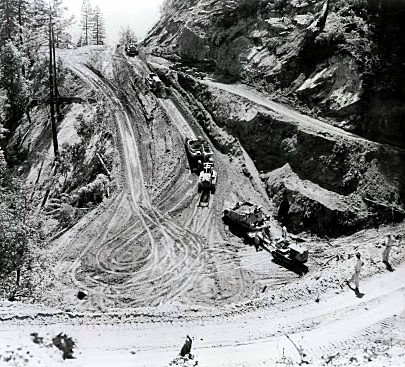
Road. The excavation did not simply cut a path through
a dense forest but created a road grade that was safe
for log hauling. If a grade is too steep, a trucker
must brake going downhill and chug going uphill. Road
grading entails filling in gulches and leveling out
hills. As a result of the bulldozers and the steam shovels,
grading on Masonite Road fell within the “good” range
for hauling. Eastbound the road had a maximum grade
of 6%; westbound, 8%. The picture below shows the extent
of earth-moving typically needed to achieve these grades.
Construction of Masonite
Road actually began in two directionssimultaneously—from
the west and from the east. On the western end, there
was Navarro Camp with cabins for the workers within
a half mile or less of Highway 128. On the eastern end,
Low Gap Camp provided tents for the workers. Workers
at the Low Gap Camp likely received supplies via an
old Indian trail, later known as the ranch road, Windy
Gap (Sweeley).
The Low Gap construction crew
did not break ground at the Ukiah terminus of the Masonite
Road but several miles further west. It was not until February
9, 1949, that “a new steam shovel was set up at the junction
of the Orr Springs road three miles west of Ukiah and
bulldozers broke the first ground” to connect Ukiah with the
rest of the construction (The Redwood Journal,
February 10, 1949).
Finally on July 14, 1949,
the power shovels of the Low Gap and Navarro crews faced off as
they met close to Wholy’s Pass, named after the general
manager of Masonite Corporation, E.T.F. Wohlenberg.
Two months later, Masonite Corporation had its completed
logging road. Not until 1952 was Masonite Road oiled
and sealed, taking on the hard-top surface that is familiar
to local residents today (Ukiah Daily Journal,
March 11, 2001). Shortly after the completion of Masonite
Road, an article in the Humboldt Times (September
3, 1950) touted the construction of the “super” logging
road and its benefits to the off-highway trucker.
|
The road cuts through
hills and along the sides of mountains. It was built by
Utah Construction company which had to move more than
five million cubic yards of earth and rock. Several cuts
exceed 60 feet in depth and one gulch is crossed by a
fill 84 feet high on the center line. No bridges are
used and some steel culverts are nine feet in diameter.
The roadway is 40 feet wide with a 30-foot finished
surface of gravel twelve inches thick. Calcium chloride
will be used to lay the dust. The road has been
described as a ‘trucker’s dream’ and permits loads of
more than 20,000 board feet, compared with the highway
maximum of 5000 board feet per load. The highway width
limit for the bunks on which logs are laid is eight feet
but ten and twelve foot bunks are used on Masonite’s
private road. Trucks operating on the private road are
not required to pay a license or a gas tax.
|
In the construction of Masonite
Road, several million board feet of right-of-way trees
were felled. Road crews cleared not only Masonite timber
stands but those of other  cooperative land owners like the Standish and Hickey
Company and the Union Lumber Company (The Redwood
Journal, March 29, cooperative land owners like the Standish and Hickey
Company and the Union Lumber Company (The Redwood
Journal, March 29, 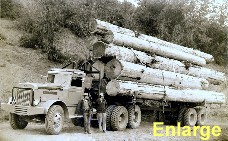 1948). On October
4, 1949, the first load of logs—100,000 pounds of right-a-way
logs—made a 27.5 mile trip over Masonite Road from the
Navarro River to the Masonite plant north of Ukiah in
1 hour and 20 minutes (Redwood Journal Press,
October 5,1949). The Douglas-fir and redwood logs onboard
were not the "giants" that were to follow. Later that
month the Redwood Journal Press (October 24,
1949) would report the first "he-man load"—approximately
100 tons—to traverse Masonite Road for its destination
at the Hollow Tree Lumber Company in Ukiah.. The weight
of the logs, the truck, and the rigging was about 250,000
pounds in total. 1948). On October
4, 1949, the first load of logs—100,000 pounds of right-a-way
logs—made a 27.5 mile trip over Masonite Road from the
Navarro River to the Masonite plant north of Ukiah in
1 hour and 20 minutes (Redwood Journal Press,
October 5,1949). The Douglas-fir and redwood logs onboard
were not the "giants" that were to follow. Later that
month the Redwood Journal Press (October 24,
1949) would report the first "he-man load"—approximately
100 tons—to traverse Masonite Road for its destination
at the Hollow Tree Lumber Company in Ukiah.. The weight
of the logs, the truck, and the rigging was about 250,000
pounds in total.
Less than a year after this
big haul, Jack Sweeley
joined Masonite Corporation in July 1950 as a young
forester out of University of California (Berkeley).
More than 30 years later, he retired as chief forester
of Masonite Corporation. In 2006, while tearing down
a shed at his home in Ukiah, Sweeley discovered the
historic photograph shown
in the 1949 news article. At an interview in the MRC
Forestry Office in January 2007, Sweeley, with the experienced
eye of an oldtime forester, recounted details about
the photo that a casual observer would overlook ( wm 5.7MB) wm 5.7MB)
As interesting as the construction
details of Masonite Road may be, so also is the history
behind its construction. Masonite Road owed its existence
to three companies each of which was a leader in its
own industry—Southern Pacific Railroad, Masonite Corporation,
and Utah Construction Company. Find out more.
Author:
DMS
Acknowledgement
Theron Brown shared
with Mendocino Redwood Company, in January 2007, photos of the
Masonite Road construction that he obtained from the Stewart
Library at Weber State University in Utah. Stewart Library, in
turn, gave MRC permission to use the photos for our history
web site
Secondary
Sources
Baldo, Chris and Theron Brown.
The Masonite Road: The Creation of a Resource. Willits, CA:
Roots of Motive Power, December 2006.
Sweeley, Jack. Interview at MRC
Forestry Office (Ukiah, CA), January 12, 2007.
The Humboldt
Times was founded in Eureka, CA in 1854, underwent later
name changes, and finally merged in 1967 with the Humboldt
Standard. Archived copies of The Humboldt Times
are at Humboldt State Univesity. Some articles from
The Humboldt Times related to the Masonite Road are
on file at Held-Poage Memorial Home and Research Library in
Ukiah, CA.
The Redwood Journal was
founded in 1860 as a weekly publication. Known as the
The Redwood Journal until 1954, it eventually
became, after other interim name changes, the Ukiah
Daily Journal. Archived copies of The
Redwood Journal and the Ukiah Daily Journal
are at the Held-Poage Memorial Home and Research
Library in Ukiah, CA.
Video
Video interview of Jack Sweeley, MRC Ukiah Forestry Office,
12 January 2007, conducted by Doris M. Schoenhoff and
Roger Krueger
|










.gif)